
Column: ‘Dead Poets Society’ and the purpose of school
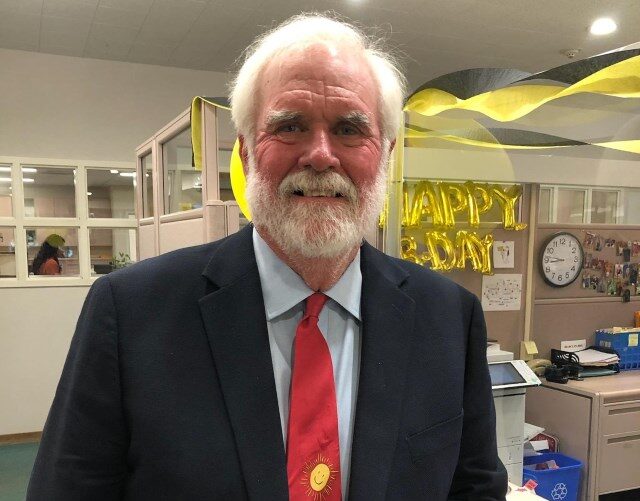
Retired Superintendent Curt Dubost.
– Robin Williams starred as English teacher Mr. Keating in the 1989 Oscar-winning drama about an unconventional teacher who returns to the stuffy New England residential prep school from which he had graduated more than a decade before. He eschews rote memorization and other traditional practices of the veteran teachers. His top priority is that the young men learn to really appreciate the classical literature that is his sole curriculum and in so doing, “carpe diem.” He refuses to waste time on secondary sources or other literary criticism or analysis as prescribed by the approved curriculum.
Several of the boys restart a secret group that Keating had once led as a student. It meets off campus in a cave to read and discuss life and poetry. One boy in particular decides as he learns to love poetry – “gather ye rosebuds while ye may” – that he wishes to pursue a career in the theater, not as the doctor his father has predetermined he should aspire to be. The end is tragic and Keating is dismissed.
Robin Williams and Ethan Hawke give great performances, and as a retired English teacher, I of course loved it both as a compelling drama and as a catalyst for discussion. What are the primary goals of mandatory school attendance? Economic advancement? Technical skills? Pleasing your parents? Admission to a selective program? Promotion? Self-actualization? Meeting your soulmate? Playing sports? Joining a group and making lifelong friends? Measurable academic achievement? Becoming an informed voter?
I describe six ideologies that are from one of my favorite professors in my doctoral studies. They define categories of educational philosophy starting with those he found to be the most right-wing and concluding with the most leftist. The titles and descriptions are not mine; they are from “Educational Ideologies” by William O’Neill (1981). I’m sure there are lots of newer categorizations, but this one still resonates with me.
Fundamentalism
The overall goal of education is to preserve, revive and reaffirm the older, better ways. To that end, schools should stick rigorously to basic skills instruction (reading, writing and arithmetic) and ensure the curriculum focuses primarily on its stated core academic aims. Political correctness and rewriting traditional history, even if undeniably accurate, are to be opposed. The traditional definition of separation of church and state is interpreted far less strictly and is to be challenged.
Intellectualism
The primary goal of an education is to identify, preserve and pass on truth. All students should receive a common core curriculum that includes study of the enduring classics and the great minds that have stood the test of time in order that they become educated, productive members of a democratic society. While a wide background of knowledge is needed, the ability to use that knowledge to reason and problem-solve is most valued. To that end, Socratic dialogue is a preferred method of instruction. The emphasis is more on teaching subject matter and less on teaching students as individuals with different levels of interest and ability.
Conservatism
Add to much of the above the goal of preserving/restoring a social order that seems threatened. In particular, teach respect for law and order and the existing norms of moral conduct and common sense. Strong opposition to movements such as “woke” and programs such as affirmative action. Carefully monitor curriculum and book choices to combat liberal bias.
Liberalism
Schools should focus on the individual needs of all students and provide opportunities to promote positive behavior. In addition to basic core academic areas of math, science, history and English, the curriculum should have a wide variety of elective options and career pathways. Students should learn skills and knowledge needed to adapt to a rapidly changing world. Equality of opportunity for all is championed. Emphasis is on the total child. Priority is to teach students the curriculum as well as positive values and at a level appropriate to the student.
Liberationism
Schools exist to feed the engines of fundamental reform of society. Existing social norms are inherently biased and beyond reform; hence, they must be replaced with more equitable institutions dedicated to promoting equality.
Anarchism
Any formal mandatory school system is inherently corrupt and does more harm than good for kids. Replace school with support for individual students as requested.
These are loose summaries, and I’m sure most everyone can find fault with something listed. I may in a future column supply 10 multiple-choice questions to answer that will show which of the six descriptions (according to O’Neill’s research) best match your beliefs. I doubt many of you will fall solely within one description. I don’t, as I personally agree most with the statements under Intellectualism, but some of my responses fell solidly under Liberalism.
In a previous column, I shared how, on the first day of graduate school at Stanford, which was considered the top graduate school of education, we were all asked what we wanted to teach. I said high school Advanced Placement English literature. The rest of the class answered similarly whatever their chosen grade level or subject.
The professor noted none of us had mentioned we wanted to teach students. That set the tone for the master’s program; we should prioritize the students in our planning, and to perhaps a lesser degree, completion of the prescribed course of study.
I recall thinking, too late, that the best answer would have been “I want to teach kids to both learn and love literature.” I could have added: using modern strategies that work, that don’t just entertain, and always with rigor, relevance and relationship.
Mr. Keating was accused of having low standards because he used unconventional methods. To the contrary, he had high standards and was not an easy grader. The students learned to love the material and why it was worth learning from a teacher they loved and who loved them. Mr. Keating taught classic literature to students who quite likely were predisposed to suffer through, not appreciate, poetry. He also got them to truly value if not love what the classics have to share. If only he’d had the wisdom to somehow see how at risk Neil was and to intervene and not carry that burden the rest of his life.
I can’t imagine a better end to a career for a teacher, though, than to have the students stand on their desks reciting “O Captain! My Captain!” as you leave your classroom for the last time.
– Former Paso Robles Joint Unified School District Superintendent Curt Dubost
Editor’s note: Opinion pieces and letters to the editor are the personal opinions of the authors and do not necessarily reflect the views of the Paso Robles Daily News or its staff. We welcome letters from local residents regarding relevant local topics. To submit one, click here.