
Op-ed: Affordable homes, stronger community
– I’ll be honest — it’s been a long time since I rented or bought my first home. Like many in our community, I’m somewhat removed from the housing realities that younger people and working families are facing today. But that disconnect is exactly why this conversation matters.
Housing today is fundamentally different from it was even a decade ago. And if we don’t take the time to understand those realities, we risk making decisions that don’t reflect the needs of our community.
This isn’t just about housing — it’s about whether people can stay, build a life here, and be part of Paso Robles’ future.
What Does “Affordable Housing” Actually Mean?
At its core, affordability reflects the relationship between what households earn and what housing costs—and it applies to both renters and homeowners, across all income levels.
Housing is considered affordable when a household spends no more than 30% of its income on housing costs—whether that’s rent or a mortgage, plus utilities and other related expenses. When that rises above 30%, a household is cost-burdened, and at 35% or more, the burden becomes severe.
In the North County, 44% of renters spend more than 35% of their income on rent. (SLO County State of the Workforce Report)
Definitions, Income, and Rents
Understanding affordability starts with two things: local incomes and the rents tied to them.
In the housing context, income levels have strict definitions set by the state relative to Area Median Income (AMI).
- Acutely Low Income: ~15% of AMI
- Extremely Low Income: up to 30% of AMI
- Very Low Income: up to 50% of AMI
- Low Income: up to 80% of AMI
- Moderate Income: up to 120% of AMI
- Workforce: up to 160% of AMI
“Low income” is a specific level (up to 80% of AMI), though it’s often used more broadly to describe households from acutely low through low income levels.
The county median income is $87,900 for a household of one, and $125,600 for a household of four.
To understand how these income levels translate in practice, it helps to look at local wages.
The county workforce report shows:
- Many common jobs pay roughly $30,000–$55,000 annually ($2,500–$4,600/month)
- Entry-level and service roles often fall closer to $25,000–$40,000 annually ($2,100–$3,300/month)
- Even mid-range roles frequently remain below $60,000 annually (about $5,000/month)
The SLO County State of the Workforce Report shows:
- Workers are concentrated in very low and low-income categories
- North County communities like Paso Robles have clusters of lower-income households
Affordable rents are calculated based on standard household size assumptions tied to unit type (for example, a one-bedroom unit typically serves one to two people, a two-bedroom two to four people, etc.), and can vary slightly depending on household size.
At $25 per hour (about $4,333 per month), a person can afford roughly $1,300 per month (including rent and utilities)—and is considered low income.
Monthly affordable rents are defined by San Luis Obispo County using actual Area Median Income data:
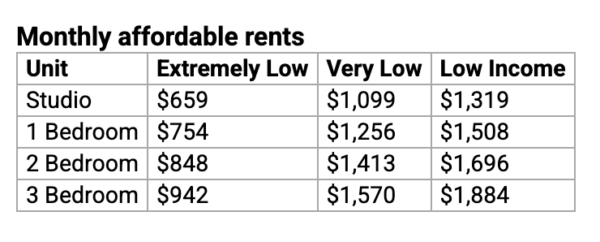
These rents reflect what households can afford—not what the market charges.
The gap between wages and housing costs
To understand the challenge locally, you have to look at three things together: what people earn, what housing costs, and the gap in between.
At the same time, the housing market tells a very different story. In Paso Robles, current rents are roughly:
- Studios: $1,400–$1,550
- 1-bedroom: $1,500–$2,300+
- 2-bedroom: $1,700–$2,500+
- 3-bedroom: $2,750–$3,600+
When you compare those numbers to what households can afford:
A very low-income household can afford about $1,413 for a two-bedroom
A low-income household can afford about $1,696
But market rents often exceed $2,200 or more. That creates a gap of roughly $500 to $1,000 or more per month (without including utilities) — a gap many working families simply cannot bridge.
The housing ladder:
The “housing ladder” describes how people move over time—starting in an entry-level rental, moving to a larger unit, buying a home, and later downsizing. Each step forward frees up a home for someone else. That upward mobility keeps the system moving.
The lack of accessible first-time homes creates a logjam in the rental market. With rising home prices, many young professionals and working families are effectively priced out, stuck renting longer than they otherwise would.
It’s not just about the overall supply of housing—it’s about the type of supply. Communities need homes that match the needs of different households, from rentals to starter homes to move-up options. Without the right mix, mobility slows and pressures mount.
As new and different types of housing are built, older homes become more attainable.
The choices in front of us:
Are we building housing that matches our community’s needs—and for the people who truly need it? Too many families in Paso Robles are facing a heavy housing burden, spending so much on rent or mortgages that there’s little left for essentials or to get ahead.
This isn’t just about numbers—it’s about the people who serve our meals, care for our kids, support our seniors, and keep our local economy running—many of whom can no longer afford to live here. And when families are priced out, it shapes the kind of community we become. The choices we make today will define the future of Paso Robles.
Kris Beal
Paso Robles City Councilmember, District 1
Kbeal@prcity.com




Thank you, ChatGPT





Thank you, ChatGPT