
Central Coast situated on human trafficking corridor, says DA
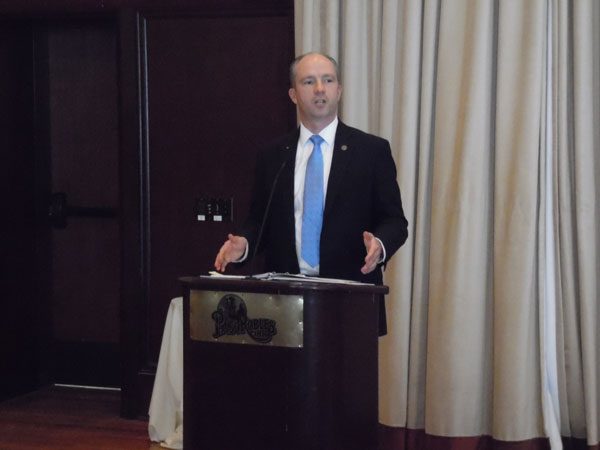
District Attorney Dan Dow speaking at the Rotary Club about human trafficking on the Central Coast.
District Attorney Dan Dow speaks to Rotary Club about human trafficking
–“More than 46 million people worldwide are enslaved and some as young as four years old.” Shocking figures from San Luis Obispo County District Attorney Dan Dow, speaking at the Paso Robles Rotary Club lunch on Thursday. Dow quoted the figures that headline the Rotary International Action Against Slavery website.
Dow said he first became aware that human trafficking was a problem on the Central Coast in 2012 while prosecuting sexual assault, domestic violence and child abuse cases as Deputy District Attorney. On that case, the San Luis Police Department worked with the Federal Bureau of Investigation (FBI) and the Fresno Police Department to free two young girls who had been kidnapped by Fresno gang members. The girls were freed after a month of being trafficked in several counties. One of the girls managed to escape from the Central Coast hotel where they were being held and called her mother who alerted local authorities. The second girl was rescued and the gang members, who fled, were ultimately arrested and prosecuted.
Dow said the Central Coast is on the human trafficking corridor between Los Angeles and San Francisco. In the 2014 report “Gangs Beyond Borders: California and the Fight Against Transnational Organized Crime,” then Attorney General Kamala Harris wrote, “As an international hub, more narcotics, weapons and humans are trafficked in and out of California than any other state.” The California human trafficking law, Penal Code Section 236.1 which was passed by California voters in 2012 as Proposition 35, defines human trafficking as “violating the liberty of another” for forced labor or services, including commercial sex acts, coercing or persuading a minor to engage in a commercial sex act, and more.
Dow spoke about a 2015 case on the Central Coast when a 15-year old girl who was lured to a romantic dinner by her 16-year old boyfriend then held captive by him and three other gang members. After trafficking her through Santa Cruz, Pismo Beach and San Luis Obispo, her captors were caught and arrested. Dow said the traffickers reportedly moved her through 24 different local locations within 24 hours for sexual activity. The four were charged with a felony under the California human trafficking law.
Other human trafficking crimes on the Central Coast include:
- The March 2016 conviction of former Cayucos fireman, Oscar Higueros, who was sentenced to more than 167 years for human trafficking of a minor.
- The January 2015 sentencing for Richard Brooks who was sentenced to more than 61 years for human trafficking, and in association with the Higueros arrest.
- At 2010 case when the owners of four Paso Robles elder care homes, Maximino and Melinda Morales were arrested for allegedly luring people from the Philippines to work as caregivers, then forced them to work for little to no pay and threatened to kill their families if they fled. A February 2012 press release from the Los Angeles Division of the FBI reported that the couple pleaded guilty to federal charges of harboring illegal aliens and were sentenced to 18 months and ordered to pay $600,000 in restitution to nine victims.
“The majority of those trafficked for sex are minors,” said Dow, “and they are both male and female victims.” Victims are marketed on the Internet and through other digital means and their captors typically traffic their victims for two or three days in one area then move on to the next place. Dow said that the rise in human trafficking is changing the “old way of thinking” about prostitution. Law enforcement no longer looks at prostitution as a crime committed on a street corner by “consenting adults.” The increase in human trafficking, which Dow said, “is slavery” is changing how police and prosecutors locally and around the nation are handling at sex crimes and sex crime investigations. The National Human Trafficking Hotline defines human trafficking as “A form of modern day slavery.” and includes “forced sex acts or soliciting labor or services against his/her will.”
In January 2015, during Human Trafficking Awareness Month, Dow announced the formation of the San Luis Obispo County Human Trafficking Task Force. The Task Force is comprised of various county departments, federal, state and local law enforcement agencies and community based organizations. In March of this year, Dow announced the formation of the Central Coast Cyber Forensics Lab (CCCFL) and the California Cyber Training Complex (CCTC). The CCCFL is part of the new CCTC based at Camp San Luis. Both endeavors formed in partnership with Cal Poly, the National Guard and other statewide organizations. In Thursday’s presentation Dow said the cyber forensics lab will be very helpful in human traffic investigations and prosecutions. Dow said traffickers are doing most of their business through digital networks, including text messaging, and that it is important to be able to track and collect this activity in a manner that helps ensure successful prosecution.
Dow said the community can help by reporting suspicious activity. “If you see something, say something.” Dow said one clue would be seeing a young female with someone who seems out of character and her behavior is unusual. She might seem depressed, not making eye contact or appear distressed. “If the child seems troubled in some way, maybe dressed provocatively, call the police.”
The community can also help by getting involved with community organizations that support victims of abuse and human trafficking and by learning how to promote awareness. A few of these local Central Coast organizations are:
- CASA of San Luis Obispo County (Court Appointed Special Advocates)
- RISE, an organization providing assistance to survivors of human trafficking as well as domestic abuse.
- Central Coast Freedom Network, mobilizing the community against human trafficking.
Dow also said that that promoting awareness in churches, clubs and community service organizations, such as Rotary International, is another way to raise awareness.
.