
Cal Poly researchers study ancient microbes for new antibiotics
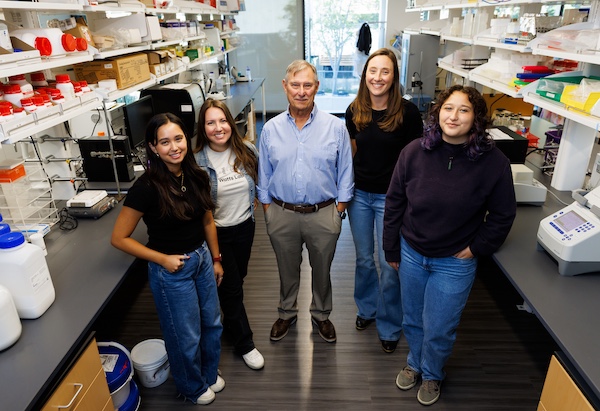
Associate Professor Katharine Watts and her undergrad research students are working in a Frost biochemistry lab doing research with bacteria isolated from the gut of a bumblebee trapped in amber 25 million to 40 million years ago, donated to the lab by retired professor Raul Cano (who collaborated with the scientists who inspired Jurassic Park). Their study may have potential applications for new antibiotics. Postdoctoral Researcher Rachel Johnson is part of the team as well. Photo by Joe Johnston/University Photographer/Cal Poly.
Project led by Professors Katharine Watts and Rachel Johnson
– A Cal Poly biochemistry research team is studying microorganisms that are 25 to 40 million years old in search of new antibiotic discoveries.
The project, led by biochemistry Professor Katharine Watts and Rachel Johnson, a Frost teacher-scholar postdoctoral fellow, examines a library of ancient microbial strains donated by Cal Poly Professor Emeritus Raul Cano. The collection includes 93 prehistoric bacteria samples extracted from amber and ocean floor sediments from the Gulf of Mexico.
The researchers aim to identify ancient strains that may produce antibiotic-like compounds and to gather genetic information to understand how they are made. According to Watts, the work could provide insights into potential benefits for modern medicine as scientists seek new treatments for antibiotic-resistant pathogens.
Scientists have successfully cultured more than 30 ancient microbes and identified seven strains with antibacterial activity. Another strain showed resistance to apramycin, an antibiotic used in veterinary medicine. Further analysis will determine the chemical structures of the antibiotic molecules and possible resistance mechanisms.
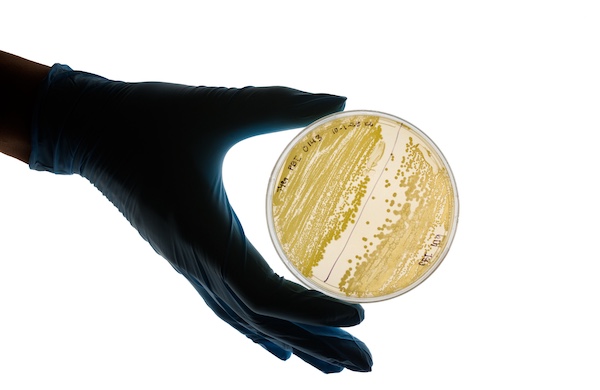
Photo by Joe Johnston/University Photographer/Cal Poly.
Cano, who taught at Cal Poly from 1974 to 2005, collected the samples decades ago from sources such as ancient amber and soil. He previously collaborated with entomologist George O. Poinar Jr., whose work inspired author Michael Crichton’s novel “Jurassic Park.” Cano became the first Cuban American inducted into the Academy of Sciences in Cuba in 2024.
While there are no current plans to design a drug, the Cal Poly team’s findings may provide new structures for antibiotic development and insights into how resistance emerges.
The project is supported by Cal Poly’s BEACoN program, which funds underrepresented students in research, and the university’s Research, Scholarly and Creative Activities Grants program. Students Safiya Rufino and Kaitlyn Calligan, both BEACoN research scholars, are among those participating in the study.
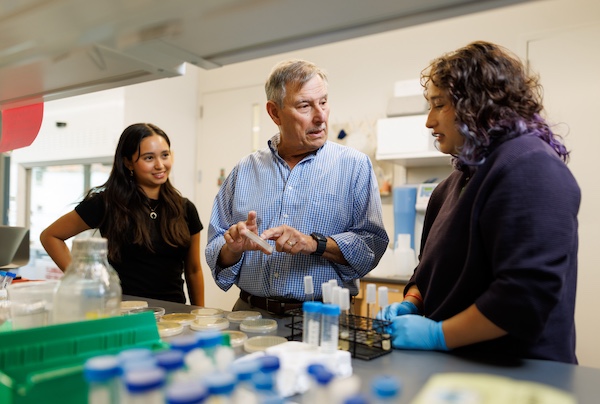
Photo by Joe Johnston/University Photographer/Cal Poly.