
Camp Roberts sees first C-17 landing on dirt airfield
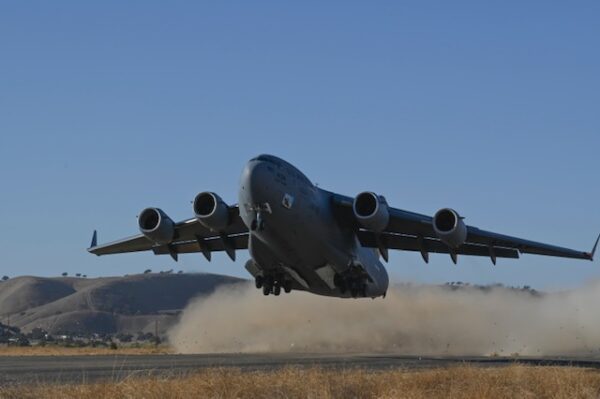
Photos courtesy Camp Roberts.
Historic C-17 landing expands Camp Roberts’ emergency response abilities
– A C-17 cargo plane made a historic landing at Camp Roberts’ dirt airfield on Wednesday afternoon, marking the first time an aircraft of that size has touched down there, according to a report by KSBY. The airfield, initially built shortly after the base opened in 1941, has remained largely underutilized due to funding limitations.
This milestone enables the base to bring in larger aircraft, expanding its capabilities for transporting supplies and personnel, which enhances preparedness for state and local emergency responses. Prior to this event, only smaller aircraft, such as helicopters and C-130s, had been able to land at Camp Roberts.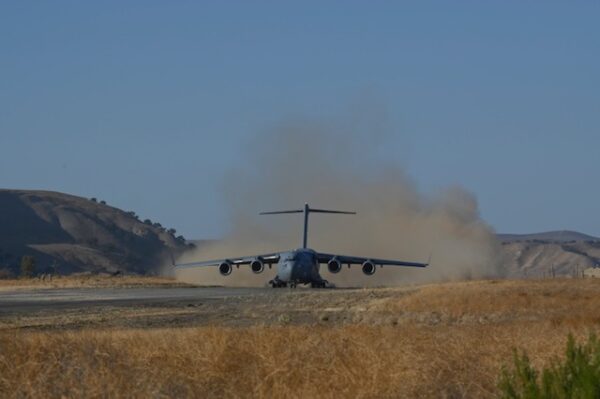
Officials emphasized that the C-17 landing will support multiple branches of the military, making the landing zone more versatile for joint operations among the Army, Air Force, Navy, and Marines. They also highlighted that the C-17’s heavy-lift capacity allows for transporting larger quantities of supplies than the smaller C-130, which has been the primary aircraft used at the base’s airfield.
While Camp Roberts is now equipped to accommodate C-17 landings, these landings are expected to occur only a few times per year.
Click here to see the report on KSBY.




Just wanted to clarify a few points in the article. As a volunteer at the Camp’s Museum I/we are always interested in the history of the Camp. So, that being said, I want to clarify a few things. First, the Camp didn’t have a formal airfield until sometime, from what little information there is, until the the early 60s. The earliest aircraft to operate off the East Garrison area were two Piper L-4 light aircraft that were assigned to Camp Roberts to support artillery training in WW2, and they just took off from the parade field there. The formal Roberts Army Airfield, doesn’t pop up in the flight charts until around 1963 or so. It supported light aircraft and helicopters of the time. Fast forward to the past year or two, and the East Garrison runway was expanded to support C-130 sized aircraft. The runway isn’t just dirt, it’s dirt that has been infused with what is known as RhinoSnot soil stabilizer. Think of it as dirt mixed with Elmer’s Glue. It hardens into solid material and has been used around the world. The more you put on, the thicker its gets. The dust you see in the pictures and videos isn’t coming from the runway, just the areas left and right and the fact that Camp Roberts is just dusty, period. The landing of the C-17 is a major increase in capability for the Camp and DoD and is the result of National Guardsmen, and the US Marines, and Camp Roberts staff working as a team. Look forward to more flight operations in the future. Good job to all.



Just wanted to clarify a few points in the article. As a volunteer at the Camp’s Museum I/we are always interested in the history of the Camp. So, that being said, I want to clarify a few things. First, the Camp didn’t have a formal airfield until sometime, from what little information there is, until the the early 60s. The earliest aircraft to operate off the East Garrison area were two Piper L-4 light aircraft that were assigned to Camp Roberts to support artillery training in WW2, and they just took off from the parade field there. The formal Roberts Army Airfield, doesn’t pop up in the flight charts until around 1963 or so. It supported light aircraft and helicopters of the time. Fast forward to the past year or two, and the East Garrison runway was expanded to support C-130 sized aircraft. The runway isn’t just dirt, it’s dirt that has been infused with what is known as RhinoSnot soil stabilizer. Think of it as dirt mixed with Elmer’s Glue. It hardens into solid material and has been used around the world. The more you put on, the thicker its gets. The dust you see in the pictures and videos isn’t coming from the runway, just the areas left and right and the fact that Camp Roberts is just dusty, period. The landing of the C-17 is a major increase in capability for the Camp and DoD and is the result of National Guardsmen, and the US Marines, and Camp Roberts staff working as a team. Look forward to more flight operations in the future. Good job to all.