
Planning commission addresses constraints on housing development
Planning Commission wants to ‘open up the conversation’ in improving current constraints, council votes to create ad hoc committee
At Tuesday’s Paso Robles City Council meeting, the Paso Robles Planning Commission presented a report to the council suggesting ways to reduce the restraints on housing development in Paso Robles.
At the Planning Commission meeting on December 9, 2014, the Commission established an Ad Hoc Committee to develop, “…creative, alternative solutions to remove or reduce constraints to housing development.”
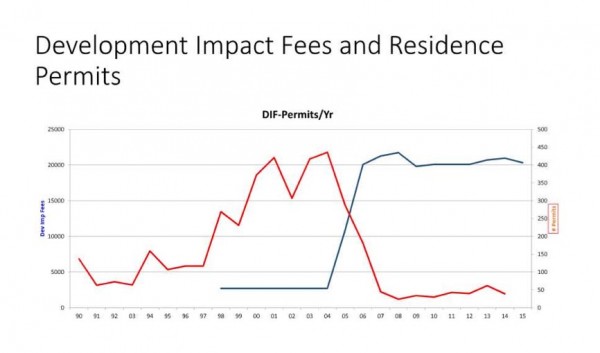
Permits issued are shown here in red, and fees shown in blue.
In the past 15 years, there was an average of 200 permits per year issued for new homes in Paso Robles. During the housing boom between 2003 and 2004, there was 400 permits issued. After the recession, between the years of 2008 and 2014, the average fell to only 50 per year, and development impact fees rose by 650 percent, according to the commission’s report.
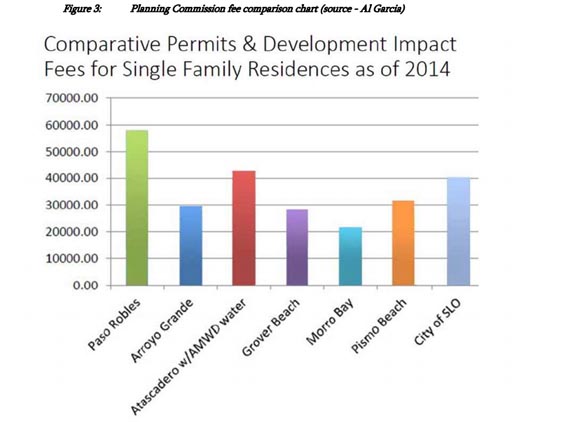 Paso Robles has the highest fees in the county for housing, roughly 30 percent higher than San Luis Obispo, and nearly twice as high as other cities in the county.
Planning Commissioner Vince Vanderlip gave the presentation regarding the housing constraints, saying that he thought that the commission had, “Two main concerns, one being that many projects failed to move forward… and the second is the three large specific plans have been stalled for over a decade,” referring to the proposed Chandler Ranch, Beechwood and Olsen housing developments.
“You can’t force builders to build, but something seems to be going on. The tipping point was habitat for humanity project,” said Vanderlip, speaking of the recent Vine street project that failed to reach completion because of financial restraints.
The commission noted that the steep fees create a lack of opportunity, lack of adequate workforce housing, and could negatively impact economic growth.
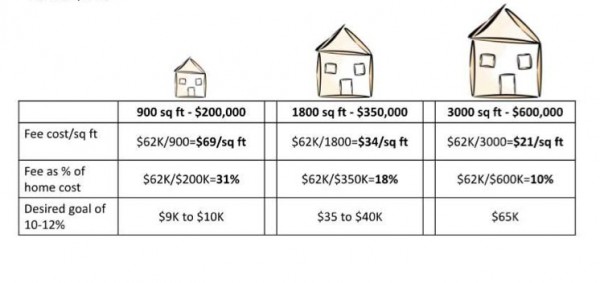 Currently, the city operates with a “one size fits all” method for determining fees, with the square footage not being taken into consideration. As Vanderlip explained, with practically no cost difference in a $350,000, “workforce” project and a $650,000 project, developers are incentivized to build more expensive projects. The average percentage that developers “expect” to pay is typically about 10 percent of the overall cost.
Planning Commissioner John Donaldson said that the commission requests the creation of a special ad hoc with wide level of diversity that will “sit down and see what will work.” He said that the reason for the report is really just to, “open up the discussion,” and figure out how to improve. “How can we look at things differently?”
The planning commission offered the following recommendations:
1) Workforce housing development: adopting a policy that encourages the development of workforce housing.
2) Re-evaluate development impact fees: completely reviewing of cost estimates for all projects defined as part of the impact fees.
3) Re-evaluate city fees: creatively developing alternative solutions that would lower city fees, such as a 5 percent reduction for buildings that don’t install lawns, or basing fees on square footage.
4) Re-evaluate the use of specific city plans: modifying the plan to more closely match the needs of the city, developers, and home buyers, taking into consideration the city’s rate of growth.
Their complete report is available here.
Warren Frace of the city planning department said that if the fees were reduced, the the list of services that the fees go to support would have to be cut. State law AB1600 states that development fees have to equal impact, that development has to, “pay it’s own way,” Frace said. Most houses generate fairly equal impact, it’s not necessarily linked to square footage, according to Frace.
“In the past, when the council has decreased fees, we have seen no correlation in a drop in the price of housing,” said City Manager Jim App.
Councilman Fred Strong pointed out that Paso Robles likely has the lowest density of population, creating the highest distribution cost for utilities like water. Higher density development drops the linear cost of utilities.
The commission was careful to note that they were urging that the council re-evaluate the fees, that it was not necessarily a call to reduce.
The Public Facilities list from the City’s AB 1600 fee study lists all of the different facilities that are currently classified as development impact. The list shows the cost of all the facilities and the percentage of cost that is the responsibility of new development, which averages out to about 40 percent.
Councilman Fred Strong made a move to receive and file the report, moving forward with the plans to streamline the permit process, but it failed to pass 2-3, with Council members Reed and Hamon voting no. Councilman John Hamon moved for an ad hoc to be created, and the motion was passed 4-1 with Mayor Steve Martin voting no.




I'm glad to see the City consider the exorbitant costs of development. Many builders are holding back because of the fees. We do need more housing, as there is a huge demand for it. Of course, water resources need to be considered, too, in approving any building plans.

If the city reduces development fees, then the residents of Paso Robles will have to make up the difference. Costs for water, sewage, and roads will have to be subsidized by city taxpayers.
"Workforce housing" developments are being pushed by the state of California and the federal government for agricultural workers. By subsidizing these grant developments, city residents will be paying for housing for the ag workers for the vineyards. These people will get low cost housing in houses better than what many of our residents can afford–regardless of citizenship in the US.
REal estate agents will be left out of the equation as these houses will be sold directly to the people who qualify.
Don't be deceived by the term 'workforce housing". When it comes to government grants, it means housing for agricultural workers, housing that the county should consider, not the city where workers will have to travel to their jobs and back, adding to highway traffic levels.

With the City so set on further development, Paso will not be a small town much longer! Very sad!!

Hi Lynne, I am a new planning commissioner and have been looking into this topic for the past couple months. As defined here in Paso Robles, workforce housing is priced higher than "low income housing" or "affordable housing". Workforce housing is for those earning 120% of the median income for the area. So it is middle class housing. It is not subsidized. Regarding the city tax payers having to make up the difference, I see your point. The city is already committed to building and paying for the Nacimiento pipeline, water treatment plant and waste water treatment plant. The budgets for these projects anticipated new developments to pay for much of the costs. If we scare development away because our fees are too high, then locals will bear 100% of the burden of paying for those projects. There must be some middle ground.



I'm glad to see the City consider the exorbitant costs of development. Many builders are holding back because of the fees. We do need more housing, as there is a huge demand for it. Of course, water resources need to be considered, too, in approving any building plans.
If the city reduces development fees, then the residents of Paso Robles will have to make up the difference. Costs for water, sewage, and roads will have to be subsidized by city taxpayers.
"Workforce housing" developments are being pushed by the state of California and the federal government for agricultural workers. By subsidizing these grant developments, city residents will be paying for housing for the ag workers for the vineyards. These people will get low cost housing in houses better than what many of our residents can afford–regardless of citizenship in the US.
REal estate agents will be left out of the equation as these houses will be sold directly to the people who qualify.
Don't be deceived by the term 'workforce housing". When it comes to government grants, it means housing for agricultural workers, housing that the county should consider, not the city where workers will have to travel to their jobs and back, adding to highway traffic levels.
With the City so set on further development, Paso will not be a small town much longer! Very sad!!
Hi Lynne, I am a new planning commissioner and have been looking into this topic for the past couple months. As defined here in Paso Robles, workforce housing is priced higher than "low income housing" or "affordable housing". Workforce housing is for those earning 120% of the median income for the area. So it is middle class housing. It is not subsidized. Regarding the city tax payers having to make up the difference, I see your point. The city is already committed to building and paying for the Nacimiento pipeline, water treatment plant and waste water treatment plant. The budgets for these projects anticipated new developments to pay for much of the costs. If we scare development away because our fees are too high, then locals will bear 100% of the burden of paying for those projects. There must be some middle ground.